December 16, 2025
December 16, 2025
AI Agents in Weather: What’s Real, What’s Hype, and What Users Think
There’s a lot of buzz about AI agents. Your inbox might look like this:
- “Launching MCP!”
- “Game-changing agentic workflows!”
- “A new AI Agent is here!”
In this post, we break down what MCP actually is—without engineering jargon—then explore whether an AI agent can truly replicate meteorological expertise. We also share what users across energy, utilities, and agriculture are saying about AI agents in weather.
What Is MCP? A Non-Technical Overview
Before we dive in, let’s start with basic terminology:
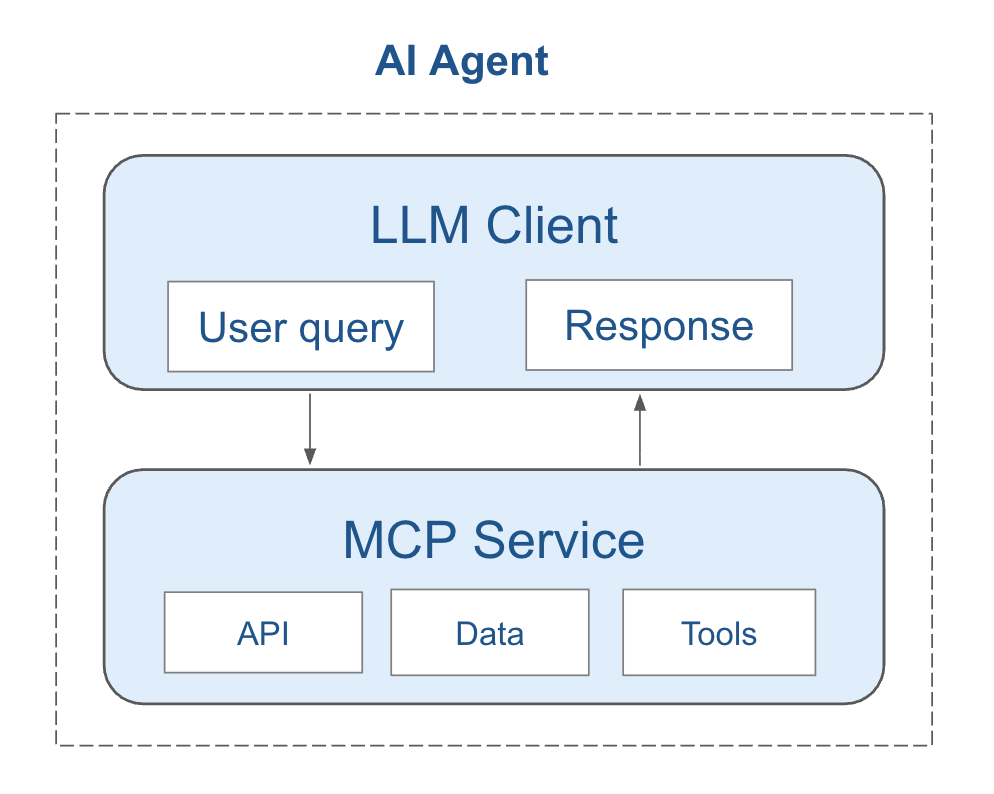
Model Context Protocol (MCP) is a standardized framework that enables AI LLMs (large language models) like GPT-4, Claude or Gemini to communicate with a Context.
The context is the data (e.g. documentation, databases), tools (e.g. APIs), and workflows (specialized prompts).
An MCP service is a program that uses the Model Context Protocol (MCP) to provide AI agents with access to external data, tools, and other resources.
An AI agent is an autonomous system that interprets user prompts and uses available tools (e.g., APIs) to take specific actions such as retrieving data and generating responses. Examples include Siri, customer service bots, and scheduling assistants.
Agentic workflows are workflows where multiple agents, humans, and services collaborate, using AI-driven decision points to complete complex tasks.
Can an AI Agent Provide Weather Insights?
Let’s look at the types of questions a meteorology (Met) AI agent might need to field and whether today’s technology can handle them.
1. Quantitative Forecast Data
Examples:
- “What’s the temperature forecast for Dallas next week?”
- “Will it rain in NYC next week?”
- “What’s the probability of wind gusts over 55 mph in Florida this month?”
Yes — An AI Met Agent connected to a context with high-skill probabilistic models can reliably answer these questions.
2. Comparative Forecast Analysis
Examples:
- “Which model is most skillful for winter temperatures in Dallas?”
- “Are next-month temperature forecasts from the Euro and American models diverging in ERCOT?”
- “Will Germany’s winter be mild or harsh compared to the last 5 years?”
Yes — An AI agent can run these comparisons if they have access to a context with public and proprietary models, hindcasts, and climatology,
3. Domain-Specific Weather Impact
Examples:
- “Any extreme-cold risk in ERCOT next month?”
- “HDD/CDD anomalies in MISO next month?”
- “Earliest planting window for barley in Argentina?”
- “Weather impact on winter-coat sales?”
- “Conditions that might hinder barley harvesting in the U.S. this year?”
Yes — With hazard thresholds and a decision-support layer, an AI agent can translate forecasts into domain-specific risks.
4. Climate Regimes & Teleconnection Reasoning
Examples:
- “What are the dominant drivers shaping the winter outlook?”
- “Explain the rationale for forecast confidence.”
Partially – AI models can detect signals like ENSO or MJO phases, but they cannot yet replicate critical thinking, weighing evidence, and reaching a reasoned decision the way an experienced meteorologist can. Trust built on a track record of forecasts and relationships cannot be easily replaced.. Meteorologists still play a crucial role in explaining uncertainty and providing oversight.
5. Business-specific queries
Examples:
- Should I short or go long given my current positions and portfolio strategy and the weather forecasts for the prompt month?
- Which assets in my utility’s territory will be impacted by severe weather next week?
- Will my revenue increase in the next 12 months given the seasonal solar forecasts?
Potentially: A strength of MCP is that it enables one query to span multiple data sources. In theory, complex queries could fuse several proprietary datasets such as meteorology, market prices, or prediction markets. This could enable reasoning and decision making beyond what any one source can provide.
User Feedback: Are People Ready for AI Met Agents?
We interviewed users across energy, utilities, and agriculture. Reactions ranged from skeptical to enthusiastic, with many open questions.
Skeptics
- “How do I know an AI agent is telling the truth?”
- “How does it know what an extreme event is?”
- “You can automate data collection, but meteorologists still translate data into impact.”
Explorers
- “We’re testing different LLMs for different use cases.”
- “Can it handle edge cases or only the most likely scenario?”
- “How do we ensure our prompts and proprietary data aren’t used for training?”
Believers
- “We’re already building our own agent.”
- “It’s incredibly powerful when scoped well.”
Key Challenges and How Salient's MCP Implementation Helps Solve Them
AI models powering agents and agentic workflows are becoming more sophisticated with enhanced reasoning capabilities, but risks around reliability, trust, and data security remain. MCP-based architectures help address these challenges.
Salient's MCP implementation is guided by these best practices.
1. Use High-Quality, Validated Data
- Provide the AI with high-quality knowledge and data and make it an expert on that information, rather than relying on the open internet.
- With Salient, the AI is connected with a MCP server with documentation and instructions on how to use the Salient API and interpret the data.
2. Ensure Transparency
- Expose the original data source, tool parameters, and endpoints to build trust. Salient surfaces the API call used to generate the answer.
- Enable users to audit the underlying values themselves.
3. Establish Guardrails
- Set clear expectations so that users understand what the AI can and cannot do.
- Use prompt engineering to restrict answers to validated content.
- If a tool call falls, instruct the MCP service to respond with an error message instead of making up an answer. For example, Salient returns a prompt for the agent to use if a person asks a question that is outside of the agent’s scope.
4. Protect Data Security and Privacy
- Require users to authenticate before granting access to the AI agent to control data access. With Salient, you control which users can access the agent and what data they can view.
- Consider client-server architectures where you can connect your own LLM client to an external MCP service. This enables you to choose your enterprise-compliant LLM client and ensure that your queries and user prompts are private.
- MCP clients only receive user prompts if they request a "query" parameter. Salient's MCP tools do not do this, which is verifiable through transparency measures.
Sneak peak of our Salient AI Meteorology Expert (AIME):
Salient's AIME is available for beta customers in 2026.
What’s Your Approach?
Which direction are you exploring?
- Build your own AI Met Agent
- Connect your internal LLM to an external MCP service
- Adopt a pre-built agent
We’d love to hear your perspective -- email me at jlee@salientpredictions.com.
December 16, 2025
December 16, 2025
AI Agents in Weather: What’s Real, What’s Hype, and What Users Think
There’s a lot of buzz about AI agents. Your inbox might look like this:
- “Launching MCP!”
- “Game-changing agentic workflows!”
- “A new AI Agent is here!”
In this post, we break down what MCP actually is—without engineering jargon—then explore whether an AI agent can truly replicate meteorological expertise. We also share what users across energy, utilities, and agriculture are saying about AI agents in weather.
What Is MCP? A Non-Technical Overview
Before we dive in, let’s start with basic terminology:
Model Context Protocol (MCP) is a standardized framework that enables AI LLMs (large language models) like GPT-4, Claude or Gemini to communicate with a Context.
The context is the data (e.g. documentation, databases), tools (e.g. APIs), and workflows (specialized prompts).
An MCP service is a program that uses the Model Context Protocol (MCP) to provide AI agents with access to external data, tools, and other resources.
An AI agent is an autonomous system that interprets user prompts and uses available tools (e.g., APIs) to take specific actions such as retrieving data and generating responses. Examples include Siri, customer service bots, and scheduling assistants.
Agentic workflows are workflows where multiple agents, humans, and services collaborate, using AI-driven decision points to complete complex tasks.
Can an AI Agent Provide Weather Insights?
Let’s look at the types of questions a meteorology (Met) AI agent might need to field and whether today’s technology can handle them.
1. Quantitative Forecast Data
Examples:
- “What’s the temperature forecast for Dallas next week?”
- “Will it rain in NYC next week?”
- “What’s the probability of wind gusts over 55 mph in Florida this month?”
Yes — An AI Met Agent connected to a context with high-skill probabilistic models can reliably answer these questions.
2. Comparative Forecast Analysis
Examples:
- “Which model is most skillful for winter temperatures in Dallas?”
- “Are next-month temperature forecasts from the Euro and American models diverging in ERCOT?”
- “Will Germany’s winter be mild or harsh compared to the last 5 years?”
Yes — An AI agent can run these comparisons if they have access to a context with public and proprietary models, hindcasts, and climatology,
3. Domain-Specific Weather Impact
Examples:
- “Any extreme-cold risk in ERCOT next month?”
- “HDD/CDD anomalies in MISO next month?”
- “Earliest planting window for barley in Argentina?”
- “Weather impact on winter-coat sales?”
- “Conditions that might hinder barley harvesting in the U.S. this year?”
Yes — With hazard thresholds and a decision-support layer, an AI agent can translate forecasts into domain-specific risks.
4. Climate Regimes & Teleconnection Reasoning
Examples:
- “What are the dominant drivers shaping the winter outlook?”
- “Explain the rationale for forecast confidence.”
Partially – AI models can detect signals like ENSO or MJO phases, but they cannot yet replicate critical thinking, weighing evidence, and reaching a reasoned decision the way an experienced meteorologist can. Trust built on a track record of forecasts and relationships cannot be easily replaced.. Meteorologists still play a crucial role in explaining uncertainty and providing oversight.
5. Business-specific queries
Examples:
- Should I short or go long given my current positions and portfolio strategy and the weather forecasts for the prompt month?
- Which assets in my utility’s territory will be impacted by severe weather next week?
- Will my revenue increase in the next 12 months given the seasonal solar forecasts?
Potentially: A strength of MCP is that it enables one query to span multiple data sources. In theory, complex queries could fuse several proprietary datasets such as meteorology, market prices, or prediction markets. This could enable reasoning and decision making beyond what any one source can provide.
User Feedback: Are People Ready for AI Met Agents?
We interviewed users across energy, utilities, and agriculture. Reactions ranged from skeptical to enthusiastic, with many open questions.
Skeptics
- “How do I know an AI agent is telling the truth?”
- “How does it know what an extreme event is?”
- “You can automate data collection, but meteorologists still translate data into impact.”
Explorers
- “We’re testing different LLMs for different use cases.”
- “Can it handle edge cases or only the most likely scenario?”
- “How do we ensure our prompts and proprietary data aren’t used for training?”
Believers
- “We’re already building our own agent.”
- “It’s incredibly powerful when scoped well.”
Key Challenges and How Salient's MCP Implementation Helps Solve Them
AI models powering agents and agentic workflows are becoming more sophisticated with enhanced reasoning capabilities, but risks around reliability, trust, and data security remain. MCP-based architectures help address these challenges.
Salient's MCP implementation is guided by these best practices.
1. Use High-Quality, Validated Data
- Provide the AI with high-quality knowledge and data and make it an expert on that information, rather than relying on the open internet.
- With Salient, the AI is connected with a MCP server with documentation and instructions on how to use the Salient API and interpret the data.
2. Ensure Transparency
- Expose the original data source, tool parameters, and endpoints to build trust. Salient surfaces the API call used to generate the answer.
- Enable users to audit the underlying values themselves.
3. Establish Guardrails
- Set clear expectations so that users understand what the AI can and cannot do.
- Use prompt engineering to restrict answers to validated content.
- If a tool call falls, instruct the MCP service to respond with an error message instead of making up an answer. For example, Salient returns a prompt for the agent to use if a person asks a question that is outside of the agent’s scope.
4. Protect Data Security and Privacy
- Require users to authenticate before granting access to the AI agent to control data access. With Salient, you control which users can access the agent and what data they can view.
- Consider client-server architectures where you can connect your own LLM client to an external MCP service. This enables you to choose your enterprise-compliant LLM client and ensure that your queries and user prompts are private.
- MCP clients only receive user prompts if they request a "query" parameter. Salient's MCP tools do not do this, which is verifiable through transparency measures.
Sneak peak of our Salient AI Meteorology Expert (AIME):
Salient's AIME is available for beta customers in 2026.
What’s Your Approach?
Which direction are you exploring?
- Build your own AI Met Agent
- Connect your internal LLM to an external MCP service
- Adopt a pre-built agent
We’d love to hear your perspective -- email me at jlee@salientpredictions.com.
About Salient
Salient combines ocean and land-surface data with machine learning and climate expertise to deliver accurate and reliable subseasonal-to-seasonal weather forecasts and industry insights—two to 52 weeks in advance. Bringing together leading experts in physical oceanography, climatology and the global water cycle, machine learning, and AI, Salient helps enterprise clients improve resiliency, increase preparedness, and make better decisions in the face of a rapidly changing climate. Learn more at www.salientpredictions.com and follow on LinkedIn and X.
Contact:
No items found.